
Powered by ID Integration, Inc.

Hospital asset tracking has traditionally been associated with one objective: locating equipment.
While that remains important, healthcare organizations are increasingly recognizing that visibility delivers value far beyond finding missing assets. Today's operational challenges require hospitals to understand how equipment is utilized, how resources move throughout the organization, and where workflow bottlenecks create unnecessary delays.
As healthcare systems continue to balance staffing shortages, financial pressures, and growing patient demand, visibility is becoming foundational to operational performance.
Every minute spent searching for an infusion pump, wheelchair, specialty bed, or mobile medical device represents time that cannot be spent supporting patient care.
Historically, many organizations addressed these challenges through manual inventories, spreadsheets, or reactive searches after equipment became difficult to locate.
Modern healthcare environments require a different approach.
Automated visibility enables organizations to understand not only where assets are located, but how they move, how frequently they are utilized, and where operational improvements may exist.
The greatest value of hospital asset tracking is often found in the decisions visibility enables.
Accurate utilization data can help organizations make more informed capital purchasing decisions, identify opportunities to improve equipment availability, and reduce unnecessary rentals or replacement purchases.
Instead of relying on assumptions, healthcare leaders gain access to objective operational data that supports long-term planning.
Visibility becomes a tool for improving resource utilization rather than simply locating equipment.
Many healthcare organizations begin with a successful asset tracking initiative but struggle to expand visibility into additional operational workflows.
The challenge is rarely the technology itself.
Long-term success depends on governance, integration, and designing solutions that can scale across departments while supporting existing clinical and operational processes.
Organizations that view visibility as infrastructure rather than a single departmental project are often better positioned to extend those capabilities into inventory management, surgical tray tracking, specimen chain of custody, and medical device accountability.
Hospitals do not need visibility simply to collect more data. They need information that helps reduce uncertainty, improve accountability, and support better operational decisions.
When critical workflow events are captured automatically, healthcare organizations can spend less time searching, documenting, and reconciling information while focusing more attention on delivering patient care. That shift represents the next phase of hospital asset tracking.
Healthcare leaders attending AHRMM26 are increasingly exploring enterprise visibility strategies that extend beyond isolated asset tracking projects.
Organizations visiting ID Integration at Booth 1120 will have the opportunity to discuss practical approaches for improving asset utilization, supporting inventory visibility, strengthening accountability, and building scalable operational visibility across healthcare systems.
As hospitals continue investing in digital transformation, visibility is becoming more than a technology initiative. It is becoming operational infrastructure.
Healthcare organizations have long understood that limited visibility creates operational strain, whether that strain appears as extended equipment searches, delayed surgical workflows, or inconsistent inventory performance. What has evolved in recent years is the recognition that isolated tracking efforts are insufficient in complex, multi-campus health systems. Visibility must function as an integrated infrastructure rather than as a departmental enhancement.
In many hospitals, teams still spend valuable time searching for mobile medical equipment, reconciling inventory inconsistencies, or manually verifying workflow status across departments. When clinicians cannot quickly locate equipment, when surgical teams wait on missing assets, or when hospital equipment visibility varies from campus to campus, operational pressure spreads quickly throughout the organization.
At the Track & Trace Transformation Summit 2026, leaders across clinical, operational, and IT disciplines examined how hospitals are transitioning from localized tracking initiatives to enterprise visibility strategies designed for long-term scalability. The Summit replay provides insight into what sustainable hospital asset tracking requires when organizations aim to move beyond pilots.
Many hospitals began with focused initiatives such as asset tagging within a single department or a limited healthcare asset tracking system designed to solve a specific operational pain point. These early efforts often delivered localized improvements in medical equipment tracking or asset utilization in hospitals, but they frequently lacked the architectural planning and governance structure required for enterprise expansion.
Summit discussions reinforced that hospital asset tracking must be treated as operational infrastructure. Data must integrate seamlessly into ERP and EHR platforms, executive sponsorship must guide phased deployment, and measurable objectives must define success from the outset.
Hospitals do not scale visibility by adding more dashboards. They scale by creating trusted workflow certainty across the enterprise.
Speakers identified several structural components necessary to support scalable healthcare asset tracking:
Visibility information must connect with enterprise systems to inform capital planning, supply chain strategy, compliance reporting, and operational decision-making.
Clear accountability across departments ensures that passive RFID hospital tracking initiatives mature rather than stall after initial implementation.
Structured expansion across facilities reduces risk and supports sustainable growth without overwhelming clinical teams.
Successful hospital equipment visibility programs demonstrate measurable impact in rental reduction, asset utilization, OR throughput, and supply chain resilience.
Passive RFID was discussed as a practical enabler of event-based visibility. Rather than attempting continuous real-time location monitoring of every device, many health systems are focusing on validating high-value workflow milestones such as:
This model strengthens operational certainty while minimizing disruption to clinical workflows. It also differentiates passive RFID hospital tracking from traditional RTLS approaches that prioritize continuous location data over workflow validation.
One recurring theme throughout the Track & Trace Transformation Summit 2026 was the risk of pilot fatigue. Without integration planning, executive alignment, and clearly defined enterprise metrics, even well-designed programs can remain confined to departmental scope.
Sustainable visibility programs are not built through isolated deployments alone. They emerge through architecture, integration, governance, and operational alignment that allow visibility to scale alongside the healthcare enterprise itself.
For health systems evaluating hospital asset tracking, RFID in healthcare, or broader workflow automation initiatives, the Summit replay offers a strategic framework for building durable visibility infrastructure that supports long-term operational resilience.
For years, hospitals tested visibility in isolated pilots. A department-level asset tracking initiative. A tray proof-of-concept. A limited inventory experiment.
That phase is ending.
Today, health systems are confronting a different reality. Equipment appears scarce despite sufficient inventory. OR delays are tied to tray uncertainty. Specimen chain-of-custody scrutiny is rising. Supply chain volatility exposes recall and expiration risk. Staffing shortages magnify every inefficiency.
The question is no longer whether visibility matters.
The question is how to operationalize it at an enterprise scale.
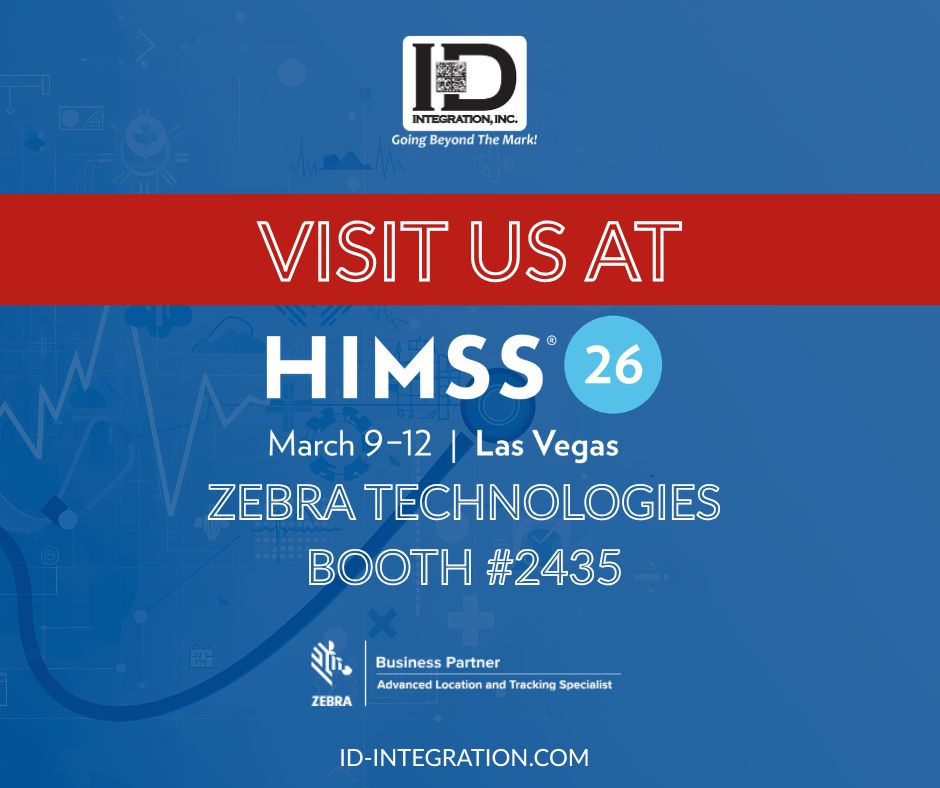
At HIMSS 2026, ID Integration will be in the Zebra Technologies Pavilion at Booth #2435 to discuss what it takes to build a reliable visibility infrastructure that supports capital planning, clinical throughput, compliance, and multi-site growth.
Asset Intelligence
Move beyond device location to utilization analytics that reduce unnecessary rentals and support data-driven capital allocation.
Surgical Tray Intelligence
Confirm wrapped trays instantly. Reduce reprocessing waste. Protect OR throughput. Strengthen compliance without increasing manual burden.
Specimen Continuity
Automate handoff validation across perioperative and lab environments to protect patient safety and audit defensibility.
Inventory Confidence
Improve expiration management and recall readiness with automated capture that integrates directly into ERP and clinical systems.
Technology alone is not a transformation. Architecture, governance, executive sponsorship, and phased deployment strategy determine whether visibility scales or stalls.
At HIMSS, our conversations will focus on measurable ROI, integration strategy, and how to avoid pilot fatigue while building a durable operational foundation.
If you are evaluating long-term modernization initiatives, let’s have a strategic discussion at Booth #2435. Reach out to our team here to schedule a time, or simply stop by the booth.
Enterprise visibility does not begin or end with equipment location. It extends across clinical workflows, sterile processing, laboratory operations, and supply chain governance.
If you are evaluating modernization initiatives, you may also find these resources valuable:
Why Hospital Tracking Programs Stall — and How to Scale Without Starting Over
EHR, LIS, and CMMS Integrations for Hospital Assets & Specimen Tracking
Healthcare operations are under pressure to do more with less—while proving it with data. If you’re responsible for surgical readiness, clinical equipment availability, specimen integrity, or supply chain performance, the Track & Trace Transformation Summit 2026 is designed for you.
Date: April 22, 2026
Location: Zebra Technologies Headquarters, Lincolnshire, Illinois
Cost: Free to attend (space is limited)
Hospitals and medical device manufacturers share a common challenge: blind spots that create delays, add cost, and erode trust. This one-day executive forum focuses on practical ways RFID, RTLS, and AI turn those blind spots into real-time visibility—without forcing a rip-and-replace approach or exposing data that should remain private.
You’ll leave with clear frameworks, peer examples, and a 90-day action plan you can use to pilot or scale traceability initiatives.

How to identify sterile-wrapped trays without breaking the seal, publish clear readiness signals to the OR board, reduce re-sterilization, and support on-time starts.
A pragmatic model that shortens “locate time,” raises utilization, curbs hoarding and rentals, and keeps PM/recalls on schedule through CMMS integration.
Ways to tighten custody, accelerate recovery, and capture cold-chain evidence—while keeping PHI in the LIS.
A shared-visibility approach that improves set turnaround, reduces loss, and strengthens billing accuracy without exposing competitive data.
How to feed EHR/LIS/CMMS with concise, audit-ready events using standard interfaces so data becomes action, not noise.
The short list that matters—first-case on-time starts, median locate time, custody completeness, utilization lift, avoided rentals, and recall closure time.
Executive briefings: Clear “what/why/how” sessions anchored in measurable outcomes.
Peer case spotlights: Lessons learned from deployments in periop, biomed, lab, and field operations.
Frameworks & checklists: Take-home tools for pilot scoping and governance.
90-day roadmap: A stepwise plan to prove value fast, then scale.
Appropriations language, accreditation expectations, and workforce realities are all moving toward automation that reduces manual effort and surfaces reliable signals to existing systems. The organizations that standardize identifiers and automate capture first will see faster throughput, fewer delays, and better capital decisions.
Venue: Zebra Technologies HQ, Lincolnshire, IL (easy access from Chicago area airports)
Cost: Free registration; seating is intentionally limited to foster high-value discussion
Audience fit: Hospital leadership teams and medical device manufacturer executives
Registration is free, but space is limited.
Bring your team’s toughest bottleneck—surgical trays, equipment availability, specimen custody, or field set visibility—and leave with a practical plan to track, trace, and transform.
